Climate Change
GRI 305
HKEX Aspect A1, A2, A3, A4 KPI A1.5, A3.1 Part D Para 19 (a) (iv), 20 (a) (b), 21, 22, 26, 28, 29, 37, 38, 39, 40
HKEX Aspect A1, A2, A3, A4 KPI A1.5, A3.1 Part D Para 19 (a) (iv), 20 (a) (b), 21, 22, 26, 28, 29, 37, 38, 39, 40
Climate Change
GRI 305
HKEX Aspect A1, A2, A3, A4 KPI A1.5, A3.1 Part D Para 19 (a) (iv), 20 (a) (b), 21, 22, 26, 28, 29, 37, 38, 39, 40
HKEX Aspect A1, A2, A3, A4 KPI A1.5, A3.1 Part D Para 19 (a) (iv), 20 (a) (b), 21, 22, 26, 28, 29, 37, 38, 39, 40
Swire Properties recognises that climate change poses significant risks and presents significant opportunities to our business. We are committed to reducing climate impacts and optimising resource efficiency throughout our operations.
We are responding to the Climate Change focus area through initiatives on mitigation, adaptation and resilience.
The relevant SDG is:
SDG 13
Taking urgent action to combat climate change and its impacts.
Our Climate Change Policy outlines our commitment to managing climate risks across our operations and to developing mitigation, adaptation and resilience strategies that address those risks in line with global best practices.
Our Approach to Physical Climate Risks and Climate Resilience
Swire Properties takes a proactive, science-based and data-driven approach to addressing physical climate risks and strengthening climate resilience in both our new developments and our existing portfolio. For new projects, comprehensive climate risk screening and hazard modelling are integrated into early investment decisions, using state-of-the-art tools and multiple climate scenarios to identify site-specific vulnerabilities such as flooding, extreme rainfall, sea level rise and heat stress.
Where material risks are identified, targeted adaptation and resilience measures, including advanced drainage upgrades, flood barriers, nature-based solutions and adaptive design strategies, are incorporated into the project design to ensure the properties are future-proof under extreme weather caused by climate change. Certain infrastructure-level measures have also been identified and actioned by local authorities to mitigate these risks.
We perform climate hazard projections associated with the multiple Shared Socio-economic Pathway (“SSP”) scenarios (SSP1-1.9, SSP1-2.6, SSP2-4.5, SSP3-7.0 and SSP5-8.5) as recommended by the United Nations Intergovernmental Panel on Climate Change’s (“IPCC”) Sixth Assessment Report, also known as AR6. More extreme low-confidence high-emissions scenarios will be considered wherever the risk is material to the properties. These scenarios range from the immediate term to the distant future and cover buildings’ lifespans, namely 2030, 2050, 2080 and 2100.
We utilised various types of hazard models, including urban drainage modelling (InfoWorks ICM), riverine modelling (HEC-RAS), coastal hydrodynamic modelling and intensified typhoon tracking and assessments to understand the urban waterlogging, riverine flooding and storm surge impacts to our properties and the surrounding neighbourhoods.
These models fully consider site and city historical flooding, the project’s architectural layout, elevation and drainage design and capacity. Detailed flood maps indicating the projected maximum flood depths, velocity and flow of flood waters were produced, and any flooding vulnerability spots identified. These analyses will form important parameters that will inform climate resilience designs in the ensuing project phases, which will involve architects, a mechanical, electrical and plumbing consultants and project teams.
Climate resilience design is integrated into our projects based on projected climate variables and design parameters, which include projected outdoor dry-bulb temperatures, extreme precipitation and rainfall intensity, sea level rises, storm surge and extreme wind speeds.
We adopt a progressive adaptive approach by implementing a medium GHG concentration scenario that focuses on developing enhancement measures up to mid-century (2050) while closely monitoring long-term climate change projections. This flexible approach allows for modifications based on changing conditions or any unforeseen impacts of climate change.
As part of our flood resilience design, we have implemented the following strategies:
- Sponge city strategies: Address future extreme rainfall events and potential urban waterlogging.
- Exterior elevation design: Set elevation higher than the maximum expected flood depth.
- Enhanced drainage capacity: Upsize drainage systems to meet projected extreme rainfall intensities that exceed standard codes, including sump pits with pumps for improved underground drainage in lower levels.
- Flood protection measures: Flood gates, curbs, and detectors are designed for underground car parks, sunken plazas and critical plant rooms.
- Nature-based solutions: Incorporate blue-green infrastructure and water detention facilities, including appropriate landscaping and rain gardens, to enhance landscape permeability and facilitate rapid rainwater collection.
To address heat stress, we focus on:
- Passive design strategies: Integrate design features that reduce reliance on mechanical cooling.
- Adaptive air-conditioning systems: Design cooling systems based on projected outdoor temperatures across various climate scenarios.
- Innovative construction materials: Choose materials that can withstand extreme heat and cold.
Continuously Progressing Towards our Science-based Targets
Continuously Progressing Towards our Science-based Targets
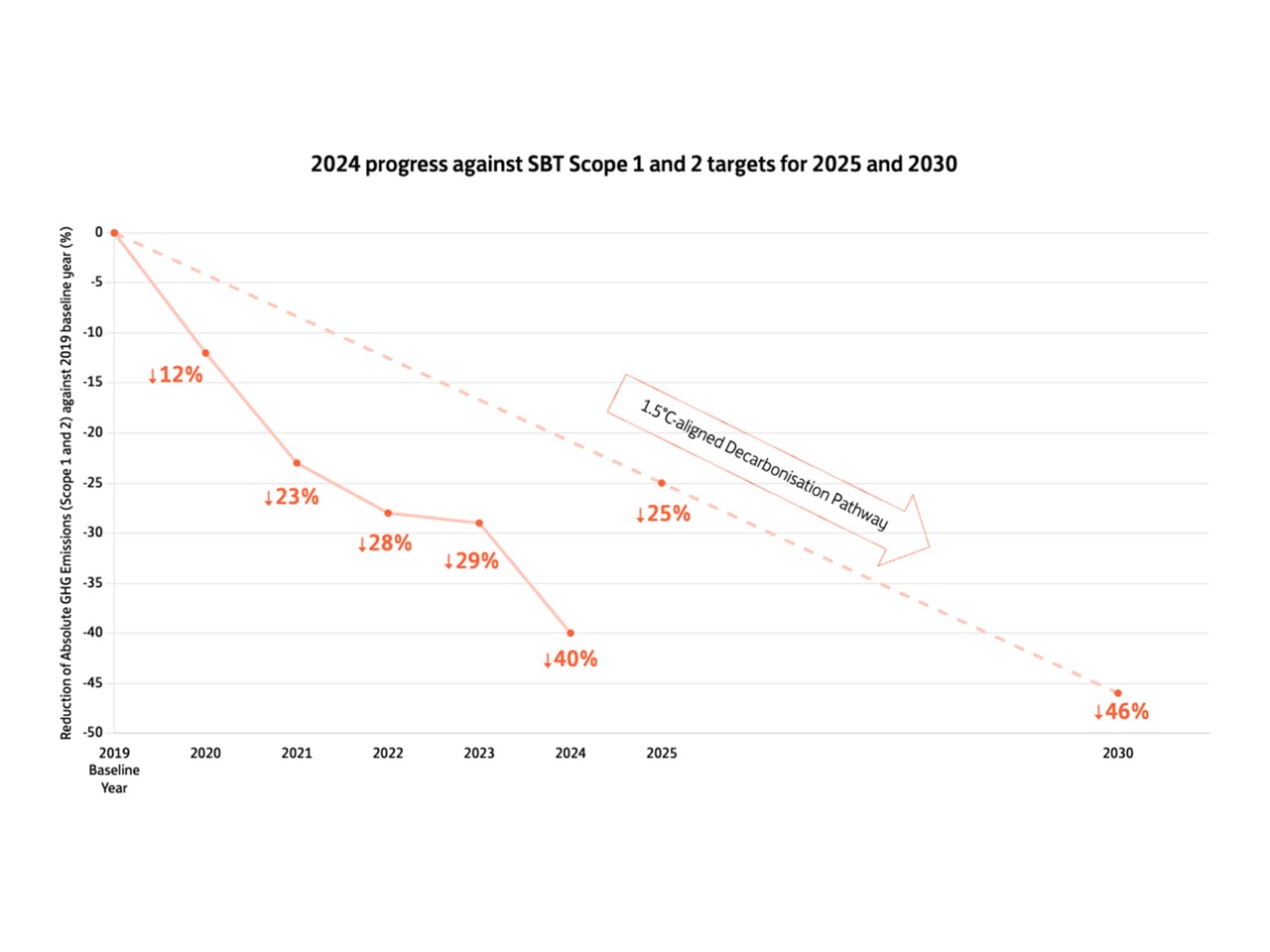
Swire Properties has set out a roadmap to guide our actions to support our net-zero commitments. Throughout 2024, we continued to adopt innovative low-carbon technologies and management practices and invest in energy efficiency, making steady progress towards our science-based targets.
Updated SBTi Building Sector-specific Targets
Swire Properties was the first company in Hong Kong and the Chinese Mainland to have its science-based targets validated and approved under the new SBTi Buildings Sector Science-Based Target-Setting Criteria (“Buildings Criteria”). We also had our net-zero targets validated by the SBTi, establishing a long-term sector-specific decarbonisation trajectory for our portfolios around the world that is in line with both the Paris Agreement and with reaching net zero by 2050. This commitment reinforces our participation in the Business Ambition for 1.5°C and the UNFCCC Race to Zero campaign.
The Buildings Criteria takes a “whole building approach”, covering all energy consumption and fugitive emissions from building operations, enhancing accountability for emissions reduction and encouraging collaboration between landlords and tenants.
This is an important and immediate step towards creating a net-zero built environment, providing businesses across the value chain with the tools to play their part in preventing the catastrophic impacts of climate change, while capitalising the opportunities of the net-zero transition.
These approved science-based targets commit us to:
Near-Term Targets
- Reducing Scope 1, 2 and 3 whole building in-use operational GHG emissions42 by 75.7% per m2 by 2034 from a 2022 base year.
- Reducing upfront embodied Scope 3 GHG emissions of new buildings43, by 69.5% per m2 by 2034 from a 2022 base year.
- Reducing Scope 3 GHG emissions from use of sold products43 by 63.8% per m2 of sold buildings by 2034 from a 2022 base year.
- Reducing absolute scope 3 GHG emissions from fuel- and energy-related activities44 by 35% by 2034 from a 2022 base year.
- Not installing any new fossil fuel equipment that is owned or financially controlled by the Company in its building portfolios as of 1 January 2030.
Swire Properties commits to reaching net-zero greenhouse gas emissions across our value chain by 2050 through the following set of long-term targets:
Long-Term Targets
- Reducing Scope 1, 2, and 3 whole building in-use operational GHG emissions43 by 98.8% per m2 by 2050 from a 2022 base year.
- Reducing upfront embodied Scope 3 GHG emissions of new buildings43 by 98.5% per m2 by 2050 from a 2022 base year.
- Reducing all other absolute Scope 3 GHG emissions 90% by 2050 from a 2022 base year.
SEE MORE IN