
SD Governance
GRI 2-9, 2-11, 2-12, 2-13, 2-14, 2-16, 2-17, 2-23, 2-24
HKEX Mandatory Disclosure Requirement Part D Para 19 (a), (b), 22 (a) (iii), (b), 26 (a) (iii), 27, 33, 34, 35, 40 (e)
HKEX Mandatory Disclosure Requirement Part D Para 19 (a), (b), 22 (a) (iii), (b), 26 (a) (iii), 27, 33, 34, 35, 40 (e)
Swire Properties’ SD governance framework builds on our strong foundations of good corporate governance and high ethical standards.
Swire Properties’ SD governance framework builds on our strong foundations of good corporate governance and high ethical standards.
SD Governance Structure
Swire Properties’ SD governance framework builds on our strong foundations of good corporate governance and high ethical standards.
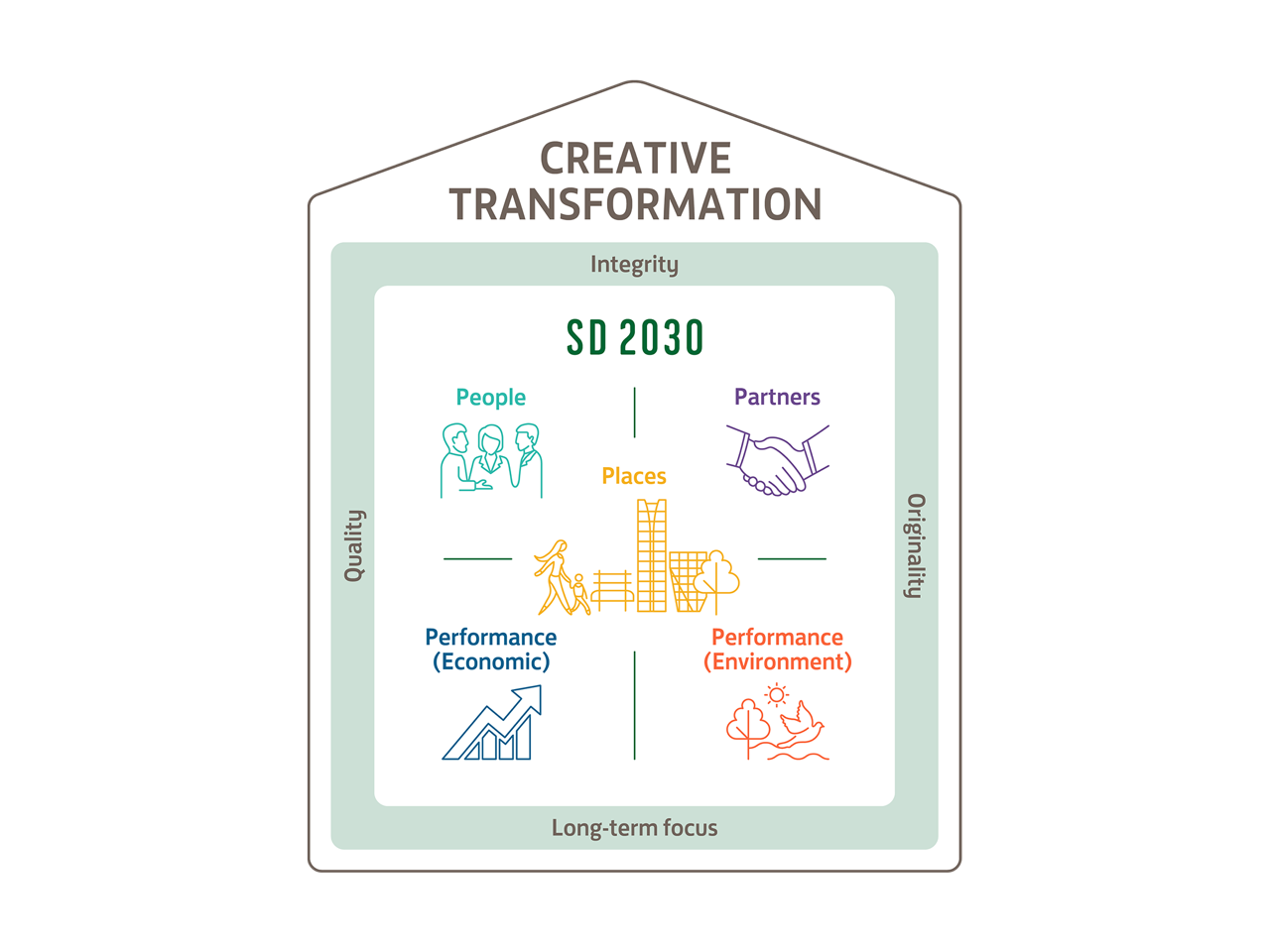
Our SD 2030 Strategy seeks to reinforce these foundations by integrating economic, social and environmental considerations into all levels of our business decision-making processes.
Sustainable Development Policy
GRI 2-23, 2-24
Our Sustainable Development Policy (“SD Policy”) was first published in 2008 and has guided the Company’s operations since then. The SD Policy is reviewed periodically and was last updated in 2021. It reflects our belief that long-term value creation depends on the sustainable development of our business, our supply chain, and the communities in which we operate. These factors are continuously considered during the inception, design, construction, occupation, and demolition phases of our development projects.
The SD Policy explicitly states that the Company will be a good steward of the biodiversity and natural resources within our influence and that we will ensure that all potentially adverse impacts of our operations are identified and managed appropriately.
With respect to the environment, our approach follows the precautionary principle10 which states, “Where there are threats of serious or irreversible damage, lack of full scientific certainty shall not be used as a reason for postponing cost-effective measures to prevent environmental degradation”.
We strive to operate in a manner that protects the health and safety of all the people with whom we work. We also strive to be an employer of choice by providing a working environment in which all employees are treated fairly and with respect in order that they realise their full potential.
Swire Properties’ Policies
Our SD Policy is supported by the following policies that focus on specific environmental and social impacts.


Integrating SD into our Business Operations
Driving Employee Engagement and SD Performance

Driving Employee Engagement and SD Performance
Support from our employees is vital to the success of our SD Strategy. To ensure that all employees remain informed and that their knowledge is up to date, we provide regular training and informational materials on climate- and nature-related topics. This training equips employees with the latest available information and ensures they are updated on our strategies to effectively address sustainability issues.
In 2018, our performance development review system was updated to engage employees in our SD 2030 Strategy on a deeper level. Office employees continued to align their annual performance goals with each Pillar of the strategy and the Company’s SD vision. In turn, these goals inform their variable compensation. In 2023, we introduced a comprehensive e-learning module covering all basic aspects of our SD 2030 Strategy and relevant ESG topics for our office employees.
Our Chief Executive, EXCOM members, relevant strategic leaders, and the General Managers of our portfolios have established corporate SD performance metrics and targets in the areas of health and safety and decarbonisation that are linked to variable compensation.
The decarbonisation goals are tied to the annual improvement of the energy use intensity performance of our existing portfolio and new developments. This allows the Company to accelerate progress towards our science-based targets by driving measurable energy and carbon reduction.
The General Managers have a balanced scorecard to monitor performance around energy and water management, staff turnover rate and training hours and performance targets related to energy management in their respective portfolios.
Business Integration and Budgeting
Business Integration and Budgeting
In 2025, we continued to implement SD initiatives in our day-to-day operations and decision-making at both the asset and functional levels of all our major business units in Hong Kong and the Chinese Mainland. All our major business units now incorporate SD considerations into their annual budgets and share proposed budget allocations with the relevant SD working groups.
Swire Properties began piloting the use of internal carbon pricing (“ICP”) in 2023 to determine the potential impacts of carbon emissions on our investments, quantify carbon risks to our business operations and better reallocate capital towards low-carbon and energy efficient investment and opportunities. ICP also facilitates engagement across departments and teams, allowing them to integrate carbon reduction strategies with business objectives and contribute to achieving our common decarbonisation goal
The ICP Committee, consisting of representatives from the FMSD and Finance departments, jointly administers the decarbonisation funds generated by ICP initiatives, which are used to finance innovative solutions to help us achieve our science-based targets. The ESGSC oversees the overall mechanism and project approval to ensure that funds are effectively channelled towards meaningful and impactful projects.
The ICP mechanism is a hybrid model comprising a carbon fee and shadow pricing. The internal carbon fee that has been set is based on the units of carbon emissions generated by Scope 1 and 2 operational emissions and Scope 3 business travel emissions generated in the previous financial year. Proceeds collected through the fee are set aside to support additional decarbonisation projects. A carbon fee of USD50/tCO2-e in 2025 brought the fee closer in line with prices forecast by the Asian Development Bank.
The shadow pricing mechanism provides additional information about the impact of emissions associated with our businesses’ capital expenditures and thus aligns the investment decision-making process with our carbon-reduction goals. It also reveals hidden risks and opportunities present throughout our operations and supports strategic decision-making related to future capital investments. The shadow pricing mechanism will be applied to planned projects that exceed a threshold value or projects that meet selected criteria. A shadow carbon price of USD110/tCO2-e in 2025 was adopted in 2025 to bring the fee into alignment with projections made by the High-Level Commission on Carbon Pricing.
A total of HKD5,872 million has been budgeted as the future three-year (2026 to 2028) forecast expenditure for climate- and nature-related projects, including funds generated from ICP.
Corporate Risk Management
Corporate Risk Management
Our Corporate Risk Register incorporates ESG-related risks, including those associated with climate and nature. We have also integrated SD and ESG factors into our corporate risk analysis.
In 2022, we began digitalising the CRR dashboard and risk scoring model. The new digitalised CRR platform offers a standard template for updating risk details, risk scoring and risk mitigation measures, making it easier to benchmark across the Group. In 2023, we optimised the system and the reporting protocol, conducting a risk workshop to identify the potential effects of geopolitical risks on our business.
In 2024, we extended the digitalised risk register to two business units, with pilots run at Citygate in Hong Kong and Taikoo Hui in Guangzhou. In 2025, the Taikoo Hui Guangzhou pilot was completed after risk mitigation measures were documented in the system. We also began conducting digitalised CRR workshops at our properties across Beijing in late 2025 and commenced a risk workshop for Pacific Place. We plan to roll out the digitalised CRR in Southeast Asia in 2026.
Swire Properties’ management will continue to monitor and conduct regular reviews of risks and the effectiveness of mitigation strategies. In 2025, we conducted 13 risk review sessions, making the relevant updates to our risk profile, ratings, and mitigation measures in the CRR. External risk advisors will also be regularly consulted to draw on their risk-management expertise, allowing us to keep abreast of industry best practices.
In 2025, our parent company, Swire Pacific, developed a sustainability risk taxonomy that provides a common language for identifying and categorising ESG risks (including climate and nature-related issues) across operating companies. During the year, cross‑functional workshops were conducted to identify or review sustainability‑related risks using this taxonomy. These identified risks were assessed, prioritised and monitored alongside all other enterprise and corporate risks using the Group’s ERM impact and vulnerability matrices for strategic planning, budgeting, and performance management. Regular management reporting tracks changes in our risk profile and the delivery of mitigation plans. Five ESG-related risks were identified during the exercise and presented to the EXCOM for discussion of corresponding risk mitigation measures.
Green Financing
Green Financing
Swire Properties is committed to integrating sustainability considerations into our financing mechanisms. By obtaining green financing, we reaffirm our commitment to sustainable development and to designing and developing sustainable projects that improve the wellbeing of building occupants and local communities.
Beginning in 2018, Swire Properties launched various green financing mechanisms to fund green building developments and other projects. These have included our first green bond, issued in January 2018, and our first sustainability-linked loan, obtained in July 2019, the interest rate of which is indexed against improvements in the Company’s year-on-year ESG performance. Since the launch of these mechanisms, Swire Properties has received reductions in the interest rates of all our signed sustainability-linked loans by achieving predetermined sustainability-linked performance targets.
In July 2023, we priced our inaugural public renminbi (“RMB”) green bonds, which we called “green dim sum bonds”, making the Company the first Hong Kong corporate to issue an RMB-denominated public green bond, and the first to return to the public dim sum bond market since 2019. This was also the largest-ever corporate green dim sum bond issuance in Hong Kong history. The transaction raised RMB3.2 billion, with the net proceeds being used to fund or refinance the Company’s existing or new eligible green projects. This issuance also demonstrates our support of the Hong Kong government’s green financing efforts, and our support of the city’s aspirations to become the world’s leading green technology and green finance centre, as well as an international offshore RMB trading hub.
As at 31st December 2025, approximately 70% of our financing was derived from green bonds and sustainability-linked loans. During the year, we issued green bonds totalling approximately HKD4.5 billion and arranged sustainability-linked loans of approximately HKD5.1 billion. We continued to update investors and analysts about our SD performance through a comprehensive ESG seminar and question-and-answer session.
In March 2026, we issued our eighth annual Green Finance Report, which provides information on projects funded by the green bonds and green loans and their estimated quantitative environmental impacts, including energy and water savings, renewable energy generation and wastewater management improvements.
MORE IN SD GOVERNANCE

SEE MORE IN